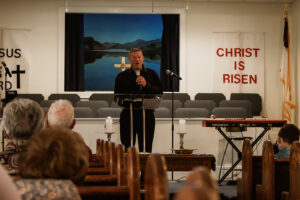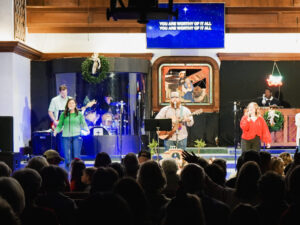
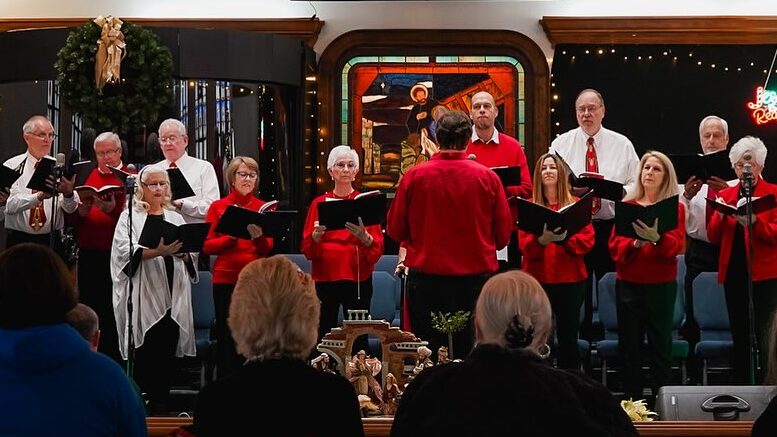
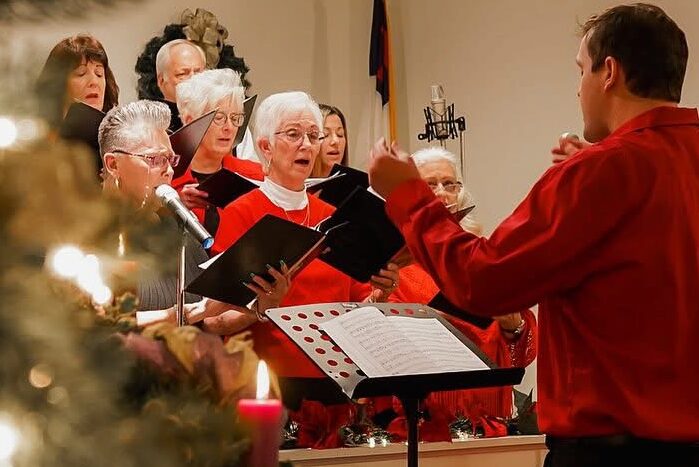
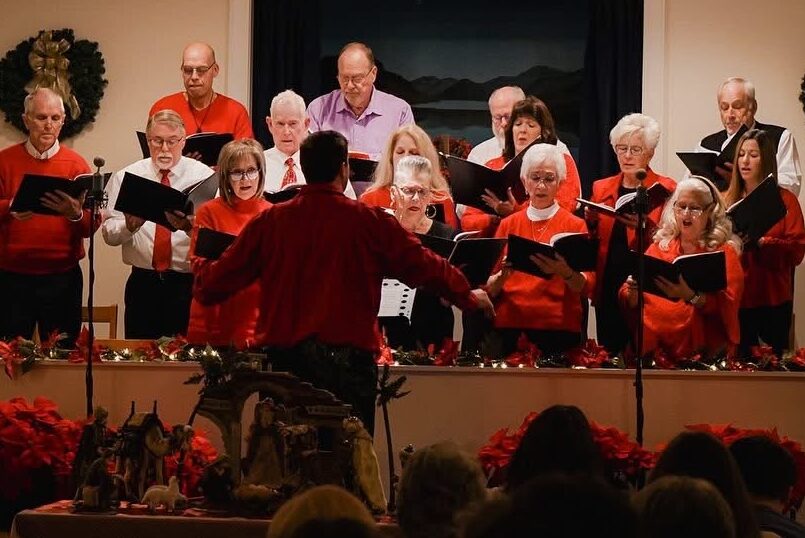
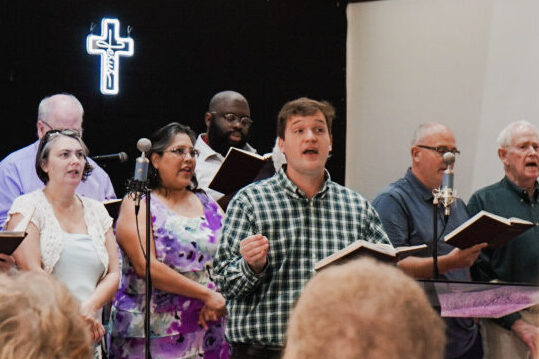
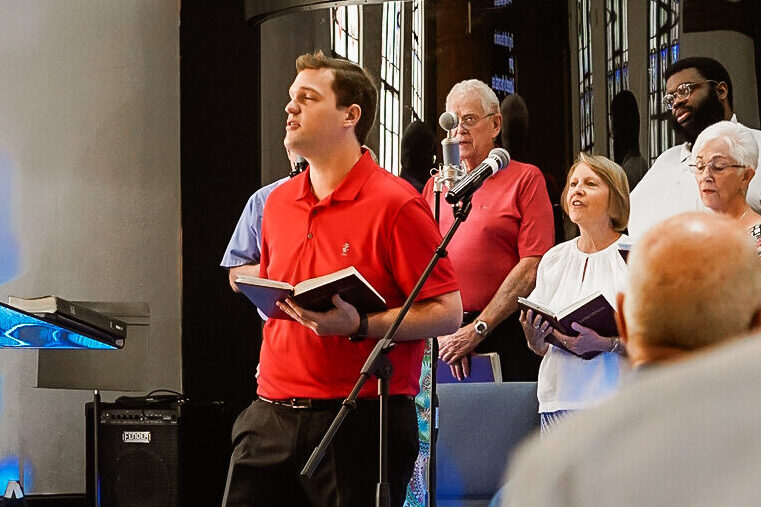
“There are moments when I’m sitting there listening and I just get goosebumps,” says Traditional Choir Director Kolton Black as he describes the upcoming Christmas cantata. “I’m really excited, and I hope people will come and just be brought into worship.”
Black has been directing the traditional choir at First Baptist for nearly two years and recently stepped into a new role as campus pastor at New Life.
When he came to FBC two years ago, he slipped effortlessly into the traditional choir director role. “It’s been a great experience, very positive,” he says. “The choir is like a little family within the church. We pray for each other. We encourage each other.”
He admits they’re working hard for this year’s Christmas cantata, and it’s stretching them all. He himself is stretching, too, as he’s now learning the ropes of leading from the pastor’s chair.
A Music Minor — God’s Ministry Bootcamp
Black’s journey to ministry started with youth work, and music was a bit of a tag along, simply because he enjoyed it so much.
“When the time came for me to figure out where I wanted to go to college, I knew youth ministry was something I was really interested in.” he explains. “My oldest brother, who’s also a pastor, was at Southeastern Seminary in Wake Forest. So, I thought, ‘Hey, why don’t I go where he’s at?’ That’s a pretty good place. When I had to choose a minor, I ended up choosing music just because I’ve always been really into music.”
But being passionate about music and leading it at church are entirely different. “I’ve played in church praise teams since I was 13,” Black says. “At that time in my life, I had terrible stage fright. I hated public speaking. I didn’t like playing music in front of people unless it was in a band. I thought I’d never be able to do music for a job.”
God knew what He was doing, though, and He led Black into music education — exactly where he needed to be to prepare him for where he is today as a traditional choir director.
The Surprising Road to Full-Time Ministry
His first opportunity to work with youth had come during his college years. Black worked as a summer camp counselor at Camp Carraway. But after he graduated and came home to work, he found a job at a machine shop. For 10 years, that’s where he spent his workdays. But he was still volunteering with the praise team, and eventually a few teenagers showed up at the church.
That’s when he started volunteering as a youth leader. In time, the youth group grew enough that the role became a part-time position. Black cut back his hours at the machine shop to invest more with the youth. When he took them to summer camp — where he fully expected God to do something for them — he was completely surprised by what God did for him. At summer camp for youth, God called his adult heart into full-time ministry.
But Black couldn’t see how it was possible. “I remember thinking, ‘What do I do now? I’m a part-time youth pastor and a part-time machine shop employee. Am I gonna have to quit my job?’”
But Black trusted and waited. Only a few months had gone by when the music director at the church stepped down, and the door opened right in front of him. He hadn’t even knocked on it! “Somebody heard that I studied music in school,” Black says. “So they asked me if I wanted to give it a try. And I did.”
And just like that, he was in full-time ministry, leading both youth and music. “I was trying to figure it out in my head what I needed to do, and God was like, ‘I already got it worked out for you. He’s been good to me like that throughout my life.”
Why Church Is More Than a Sunday Gathering
As Black has stepped into leadership at FBC-Mebane, he’s brought with him a perspective of ministry that his upbringing inspired. “I was a part of a big family,” he explains. “I have five siblings, and we were all homeschooled. So church was our community. It was our village.”
That’s given him a passion for the importance of church fellowship and people of the church doing life together. “Church isn’t this little side thing we just do when we’ve got time,” he says. “Church is a vital part of life. It’s a community of people that, as the Bible says, aren’t to neglect gathering together. We need each other, and there’s a lot of good we can do when we come together.”
Traditional Music in Today’s Church
Black’s experience as a pastor’s son, a traditional choir director, and now a pastor has given him a unique perspective on what has become one of the most divisive issues in the modern church.
“Music in church has been a major divider,” he says. “FBC-Mebane has done what a lot of churches haven’t yet been able to do. They’ve managed to make two services — where it’s all traditional in one and all contemporary in the other.” Music is highly preference driven, after all.
But for Black, the issue is deeper than style. “If you examine scripture, it really calls for freedom,” he notes. “God is just basically saying, ‘Sing to me,’ and I really think there’s a place for both [traditional and contemporary music].”
The history of hymns
He worries about losing hymns entirely, too, especially since many who wrote them were writing in response to dire hardship. Take “It Is Well with My Soul,” for example. Horatio Gates Spafford penned the well-known hymn after experiencing the loss of four young daughters in a tragedy at sea.
“We had people who were under severe persecution, people who had just lost their families, terrible things,” Black adds. “And then they would sit down and in light of those things, write the words to the hymns. With a lot of new music, some songwriters get together in a music room and, in 10 minutes, put a song together. I’m not trying to diminish contemporary music, but there’s something special about the songs that were written under such extreme circumstances, just people pouring their hearts out to God. When you learn the backstory, those words take on a whole new meaning in your life.”
His own view has changed with time. As a young man, he preferred contemporary sounds, too. Now, he says, “We put too much emphasis on style. We need to put more emphasis on what’s pleasing to God. When you do that, there’s room for it all.”
Preparing Our Hearts for Worship
On Sunday morning, as church goers make their way into the room, Black realizes everyone faces distractions. “Let’s be honest,” he says. “Especially those of us with young children, by the time we get to church, sometimes God’s almost been pushed to the back burner of our minds with all else that’s going on.”
But he agrees with the many other pastors who’ve said that church starts before you get to the building. “I feel like a lot of people struggle when they get to church to really worship,” says Black. “And I think it’s because we’re not preparing ourselves before we get there, just taking the time to open up Scripture and just read a little bit and also praying we’ll get our focus.”
He encourages taking a little time before coming to church to refocus and remember why we’re there. “That will change the music for us as well,” he reflects. “All of a sudden, it’s no longer about, ‘Is this a song I like or not?’ Now it’s about, ‘Are these words that I can sing to God and mean?’ All of a sudden, we’re worshiping to a song we may not even like.”
And worship is truly what matters most.